
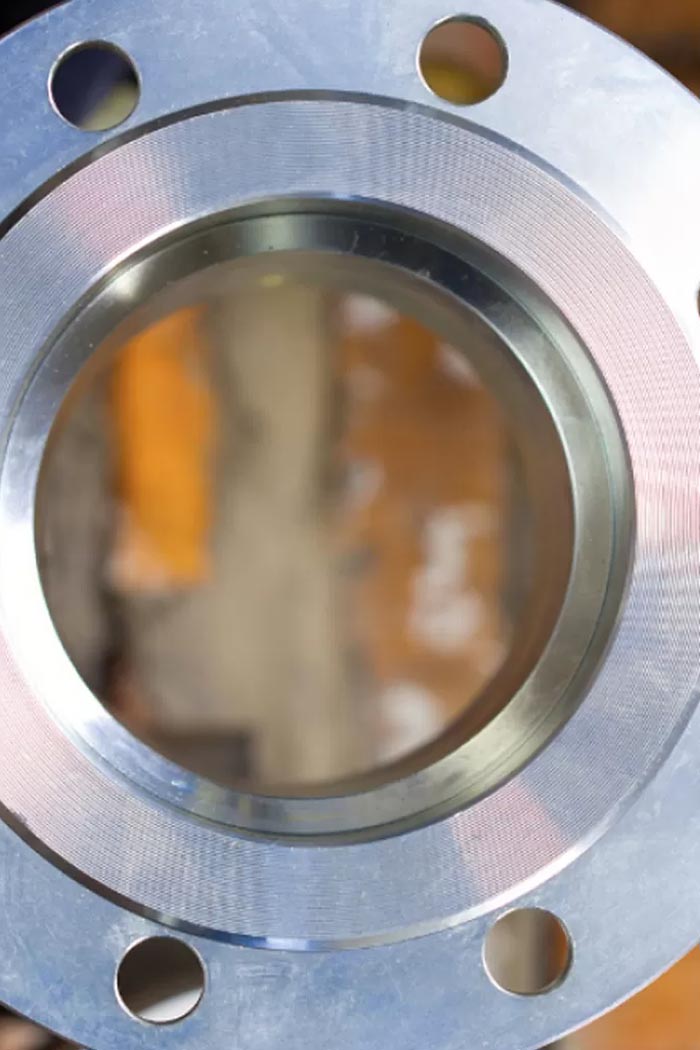
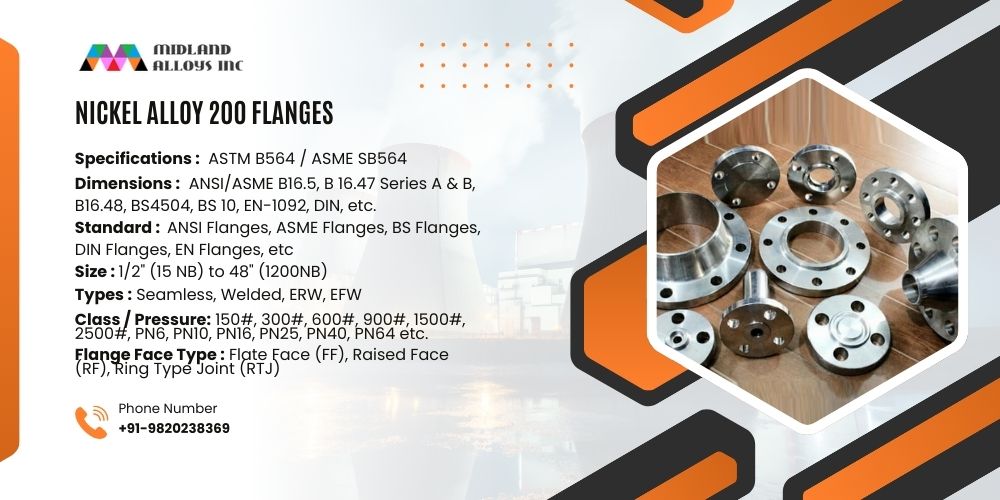
Midland Alloys Inc. is India’s trusted manufacturer and global supplier of Nickel Alloy 200 Flanges. These flanges are made of economically pure wrought nickel, which provides high corrosion resistance as well as thermal and electrical conductivity. We supply Alloy Nickel 200 Flanges in a range of standard and custom sizes, including WNRF, SORF, BLRF, Threaded, and Lap Joint types, suitable for chemical plants, marine systems, power stations, and more. Nickel Alloy 200 has over 99% pure nickel and low carbon content, making it appropriate for welding, high-purity systems, and use in caustic and acidic conditions. This unique composition provides Nickel Alloy ASTM B564 200 Flanges with exceptional resistance to alkalis, acids, hydrofluoric acid, and dry gases, even at high temperatures. These UNS 2200 flanges outperform many standard grades in corrosion-prone settings like caustic soda production, food processing, and salt-rich marine systems. ASME SB 564 Nickel 200 Flanges also have great ductility, thermal stability and resistance to cracking and stress corrosion making them simple to manufacture and dependable in severe environments. We provide both seamless and welded alternatives, designed for precision and performance in a variety of industrial environments.  We provide high-quality nickel 200 flanges at affordable rates that meet your application requirements.

nickel-alloy-200-flanges-proimg

Nickel Alloy 200 Flanges Overview

Nickel Alloy 200 Flanges are made from over 99% pure wrought nickel, offering excellent mechanical strength, corrosion resistance, and high thermal and electrical conductivity even in extreme conditions. Designed specifically for high-purity and high-performance use, nickel UNS 2200 flanges are available in types like weld neck, slip-on, socket weld, threaded, and blind connect easily to pipes, valves, and equipment across a wide range of industrial systems. Unlike nickel pipes or sheets, these flanges are built to handle corrosive environments, elevated temperatures, and moderate pressure while resisting cracking, stress corrosion and chemical attack. Their low carbon content provides great resistance to alkalis, acids and dry gases making them appropriate for aggressive and failure-sensitive applications. Manufactured to international standards, ASTM B564 Nickel Alloy 200 Flanges deliver long service life, system compatibility, and consistent reliability in industries that demand chemical purity and durability.

nickel-alloy-200-flanges

Benefits of Nickel Alloy 200 Flanges

Nickel Alloy 200 Flanges are widely used for their excellent performance in tough industrial environments. Alloy 200 Flanges are known for their strength, corrosion resistance, and low maintenance requirements. They provide long-term value in demanding applications.

  • Corrosion Resistance: Excellent resistance to moisture, chemicals, and oxidizing environments makes Nickel 200 Flanges ideal for corrosive settings.
  • Long-Term Strength: Maintains mechanical strength over time, even under high pressure and temperature.
  • Good Weldability and Ease of Fabrication: ASTM B564 UNS N02200 Blind Flanges are simple to produce, and welding makes installation easier and decreases project time.
  • Long Service Life in Extreme Conditions: Performs reliably in high heat, low temperatures and aggressive chemical exposures.
  • Suitable for Acidic and Alkaline Environments: Withstands both acidic and alkaline media, making NW 2200 Blind Flanges versatile across many industries.
  • Low Maintenance: Durable and stable structure reduces the need for frequent inspections or replacements.
  • Compatibility with Global Standards: ASME SB564 UNS N02200 Nickel 200  Conforms to international standards for quality and performance.
  • Durability: Tough build ensures resistance to impact, wear, and mechanical stress during continuous operation.

As a reputable Nickel 200 Flanges Exporter in India, we provide high-quality products that meet international standards and function reliably in essential systems.

Nickel Alloy 200 Flanges Specification

This section gives a clear overview of the technical specifications for Nickel Alloy 200 flanges. It includes details like available standards, size ranges, pressure ratings, and common flange types.

flanges icon
Sizes in Stock

1/2″NB TO 60″NB

ASTM Standard
Standard

ASTM B564 / ASME SB564

measurement and dimensions
Dimensions

ANSI/ASME B16.5, B 16.47 Series A & B, B16.48, BS4504, BS 10, EN-1092, DIN, etc.

Flange Types
Types of Flanges

Threaded / Screwed / Forged / Plate

Pressure Icon
Class / Pressure

150#, 300#, 600#, 900#, 1500#, 2500#, PN6, PN10, PN16, PN25, PN40, PN64 etc.

flange face types raised face, flat face, and ring type joint
Flange Face Type

Flate Face (FF), Raised Face (RF), Ring Type Joint (RTJ)

Process
Flanges Process

Forging, Rolling, Casting

flange thread icon
Flange Thread

FNPT, NPT, BSPT, MNPT, BSPP

Types of Nickel Alloy 200 Flanges

Nickel Alloy 200 flanges come in a variety of types to fit different piping needs, pressure levels, and installation methods. Each type offers a specific benefit based on how it connects and seals in the system.

Manufacturing Types

  • SORF (Slip-On Raised Face)
    SORF (Slip-On Raised Face)

    Slides over the pipe and gets welded for easy installation in low-pressure systems.

  • BLRF (Blind Raised Face)
    BLRF (Blind Raised Face)

    Closes off pipe ends; used for testing or sealing flow in a system.

  • SWRF (Socket Weld Raised Face)
    SWRF (Socket Weld Raised Face)

    Pipe fits into a recessed area and is welded around the edge. Ideal for small-bore, high-pressure lines.

  • WNRF (Weld Neck Raised Face)
    WNRF (Weld Neck Raised Face)

    Has a long, tapered hub and welds to the pipe for strong, leak-proof joints under high pressure.

Face Forms

  • Raised Face (RF)
    Raised Face (RF)

    The most common type has a raised surface that improves gasket sealing in medium to high pressure.

  • Ring Type Joint (RTJ)
    Ring Type Joint (RTJ)

    Uses a metal ring for sealing and works well in high-pressure, high-temperature services.

  • Flat Face (FF)
    Flat Face (FF)

    Flat surface flange used with cast iron or low-pressure piping where full face gasket is needed.

  • Lap-Joint Face (LJF)
    Lap-Joint Face (LJF)

    Used with stub ends and are easy to align and install. Good for systems that need frequent dismantling.

Contact Midland Alloys Inc. for Your Nickel Alloy 200 Flanges Needs

Contact us today to discuss how Nickel Alloy 200 Flanges can benefit your application. Whether you need guidance in selecting the right pipes or have specific requirements, our team of experts is here to help you find the optimal solution.

Technical Details & Delivery Condition

The exact chemical makeup of Nickel Alloy 200 shows the percentage of key elements like nickel, iron, carbon and others that define its purity, performance, and corrosion resistance.
Grade C Mn Si S Cu Fe Ni
Nickel 200 0.15 max 0.35 max 0.35 max 0.01 max 0.25 max 0.40 max 99.0 min
This section covers the core strength and performance values of Nickel 200 flanges. It includes important mechanical properties like tensile strength, yield strength, elongation, and hardness.
Element Density Melting Point Tensile Strength Yield Strength (0.2%Offset) Elongation
Nickel 200 8.9 g/cm3 1446 °C (2635 °F) Psi – 67000 , MPa – 462 Psi – 21500 , MPa – 148 45 %
This lists the equivalent grades of Nickel 200 flanges under different global specifications, so you can easily match materials across international codes.
STANDARD WERKSTOFF NR. UNS JIS BS GOST AFNOR EN
Nickel 200 2.4066 N02200 NW 2200 NA 11 НП-2 N-100M Ni 99.2
This section outlines the standard dimensions for Nickel 200 flanges. It includes details like outer diameter, thickness, bolt circle, and hole size to help ensure proper fit in your piping setup.
Standard Class Diameter Bolt Circle Dia No of Bolts Bolt Size Bolt Hole Dia
AS 2129 Flange Table C 95 67 4 13 14
Table D 95 67 4 13 14
Table E 95 67 4 13 14
Table F 95 67 4 13 14
Table H 114 83 4 16 17
Table J 114 83 4 16 17
ISO 7005 (DIN) Flange PN6 80 55 4 M10 11
PN10 95 65 4 M12 14
PN16 95 65 4 M12 14
PN20 90 60.5 4 M14 16
PN25 95 65 4 M12 14
PN40 95 65 4 M12 14
AS4087 PN14 95 67 4 M12 14
ANSI B16.5 ANSI 150 89 60 4 13 16
ANSI 300 95 67 4 13 16
ANSI 600 95 67 4 13 16
ANSI 900 121 83 4 19 22
ANSI 1500 121 83 4 19 22
The table shows pressure ratings across different classes and temperature ranges for safe and efficient operation.
Standard Pressure Rating
ANSI
  • 150 LBS
  • 300 LBS
  • 600 LBS
  • 900 LBS
  • 1500 LBS
  • 2500 LBS
DIN
  • PN6
  • PN10
  • PN16
  • PN25
  • PN40PN64
UNI /EN /DIN
  • 6 Bar
  • 10 Bar
  • 16 Bar
  • 25 Bar
  • 40 Bar
Nickel Alloy 200 flanges are available in a broad range of diameters.  Whether your project requires small or large diameters, you’ll find the appropriate size here to meet your system’s requirements.
Size in (In) Size in (Mm) No of Bolts Bolt UNC Size RF Stud Length Stud ISO Size Machine Flange Bolt Len
1/2 15 4 1/2 55 M14 50
3/4 20 4 1/2 65 M14 50
1 25 4 1/2 65 M14 55
1 1/2 40 4 1/2 70 M14 65
2 50 4 5/8 85 M16 70
3 80 4 5/8 90 M16 75
3 1/2 90 8 5/8 90 M16 75
6 150 8 3/4 100 M20 85
8 200 8 3/4 110 M20 90
10 250 12 7/8 115 M24 100
1 1/4 32 4 1/2 70 M14 55
2 1/2 65 4 5/8 90 M16 75
5 125 8 3/4 95 M20 85
16 400 16 1 135 M27 115
18 450 16 1 1/8 145 M30 125
20 500 20 1 1/8 160 M30 140

Nickel Alloy 200 Flanges Grades We Offer

Difference Between Nickel Alloy 200 Flanges vs Nickel Alloy 201 Flanges

Nickel Alloy is known for its superior corrosion resistance, outstanding thermal and electrical conductivity, and dependability in high-purity and chemical processing environments. Both Nickel Alloy 200 and Nickel Alloy 201 are commercially pure nickel grades used in demanding industrial setups. Nickel Alloy 200 flanges stand out for their high strength, durability and strong resistance to caustic chemicals. They work especially well in alkaline systems, food processing units, marine settings and high-purity lines where stable thermal and electrical performance is critical. While Nickel Alloy 201 provides greater performance at higher temperatures due to its lower carbon content, Nickel Alloy 200 flanges continue to be the favored choice for most low to moderate temperature applications due to their mechanical strength and higher conductivity. For industries handling chemical fluids, seawater, or clean processing environments, Nickel Alloy 200 flanges provide the right mix of corrosion protection, purity, and mechanical stability without driving up cost. Nickel Alloy 200 flanges are a trusted and widely used for critical industries, offering the right mix of strength, purity, corrosion resistance, and value.

Manufacturing Process of Nickel Alloy 200 Flanges

Midland Alloys Inc. is a leading manufacturer of Nickel Alloy 200 flanges, providing customized sizes, accurate requirements and affordable prices. To meet worldwide quality requirements, we use a thorough procedure that incorporates innovative production techniques. The process starts with selecting high-quality raw materials, then precision cutting and even heating. The flanges are subsequently formed using controlled forming, and welding stages, depending on the type. Each piece undergoes heat treatment to improve strength and durability. We apply surface finishing to ensure smooth, clean results free from defects. Throughout production, we carry out strict quality checks at every stage. Before dispatch, every flange goes through final testing, and inspection to guarantee it meets all required standards.

Raw Material

Plate

arrow
Cutting

Shear

arrow
Sizing

Press

arrow
Heat Treatment

Inspection

arrow
Pickling

Lathe

arrow
Pickling

Drilling

arrow
Beveling

Cleaning

arrow
Polishing

Flange

arrow
Inspection

Inspection

arrow
Analytic

Analytic

arrow
Marking

Marking

arrow
Packing & Shipping

Packing & Shipping

Nickel Alloy 200 Flanges Application

Nickel Alloy 200 flanges work well in the petrochemical industry for connecting pipelines that handle caustic soda, chlorine, and other strong alkalis. These flanges are used in the oil and gas industry to join pipes carrying sour gas or crude oil particularly in locations with high sulfur concentration. Power plants use them in heat exchangers and boilers where stable connections are needed for steam or hot water flow. In chemical plants, they connect vessels and process lines that carry acids and other reactive fluids. Offshore platforms rely on these flanges for pipe joints that face saltwater spray and changing pressure. Food processing units use them in piping systems that handle fats, oils and cleaning agents during production.

Our Packaging Standard

We pack every Nickel Alloy 200 flange using strong, export-grade materials to keep them safe during handling and shipping. Each flange is wrapped in HDPE or shrink film, fitted with protective end caps and stored in strong hardwood crates or on pallets. We also provide customized packaging based on your project requirements. Clear labels with grade (e.g., UNS S32750), size, standard, pressure rating, and heat number are included for simple identification and tracking.  We manage deliveries throughout India by road or rail, and international shipments by sea or air. In-stock flanges ship the same day, while custom orders follow a set delivery schedule. Every shipment includes an invoice, packing list, test certificates, and export documents when needed.

Why Choose Midland Alloys Inc.

Midland Alloys Inc. is a leading manufacturer and supplier with the experience and setup to meet your exact needs. Whether you need standard sizes or custom specs, we make it easy. Our advanced manufacturing facilities allow us to maintain great quality while keeping pricing affordable.  We follow high quality standards and have certifications such as ISO 9001:2015, PED 2014/68/EU and EN 10204 3.1/3.2 mill test certificates. We also support third-party checks by TÜV, BV, SGS, and DNV. Our flanges ship on time, whether for a local or an overseas project. With a strong global supply network and wide industry reach, we make sure you get the right product without delay or hassle.

FAQ

Choose Nickel 201 when lower carbon content is needed to prevent graphitization at temperatures above 315°C (600°F). It offers better resistance to intergranular corrosion and is ideal for high-temperature applications.

 Nickel creates effective alloys with chromium, iron, molybdenum, copper, cobalt and manganese, which improve qualities like corrosion resistance, strength, and heat resistance.

Quick Quote Request

Our experts will get back within 24 hrs.