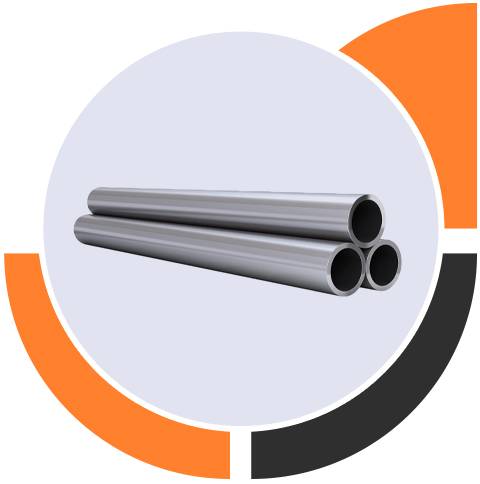
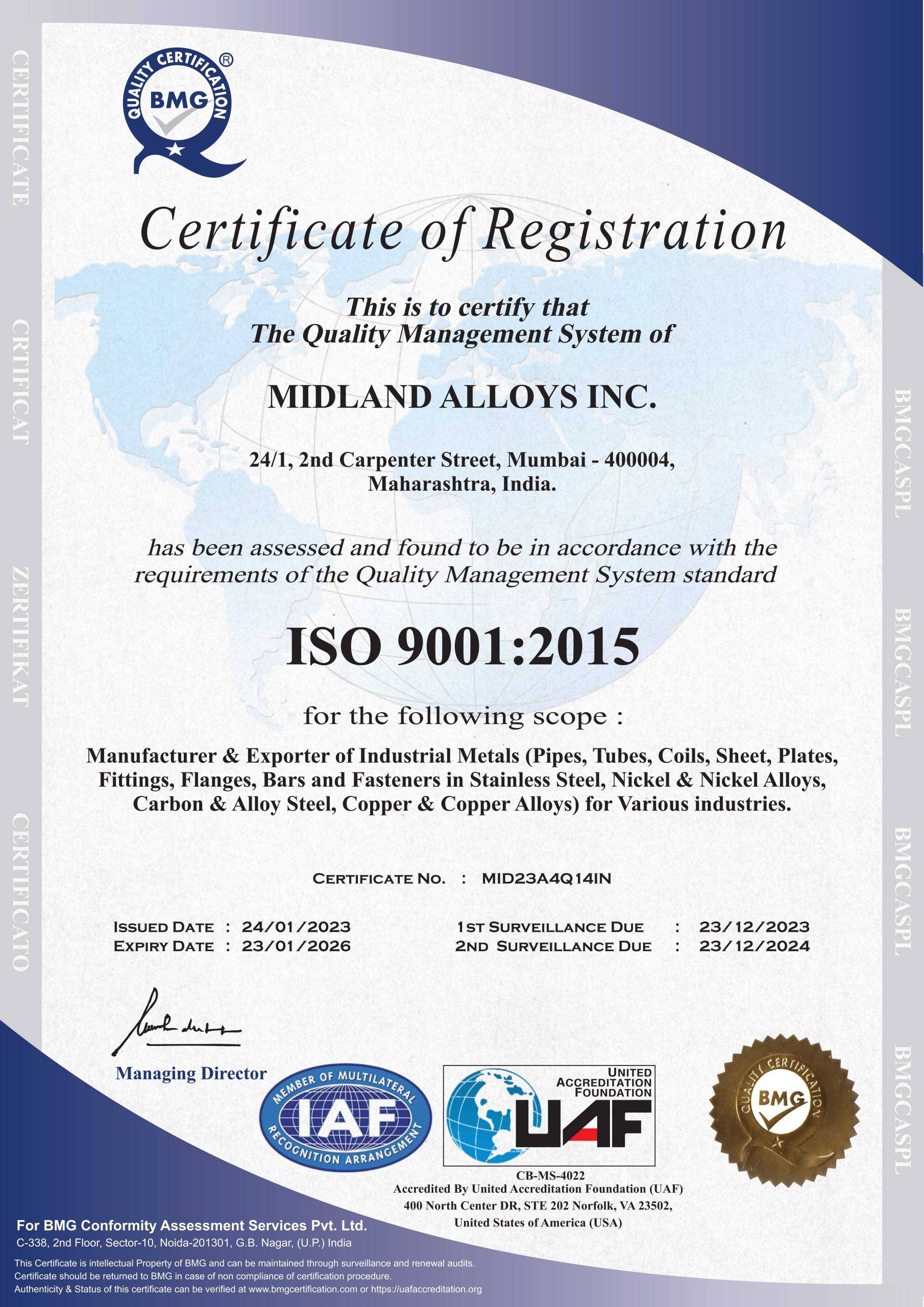
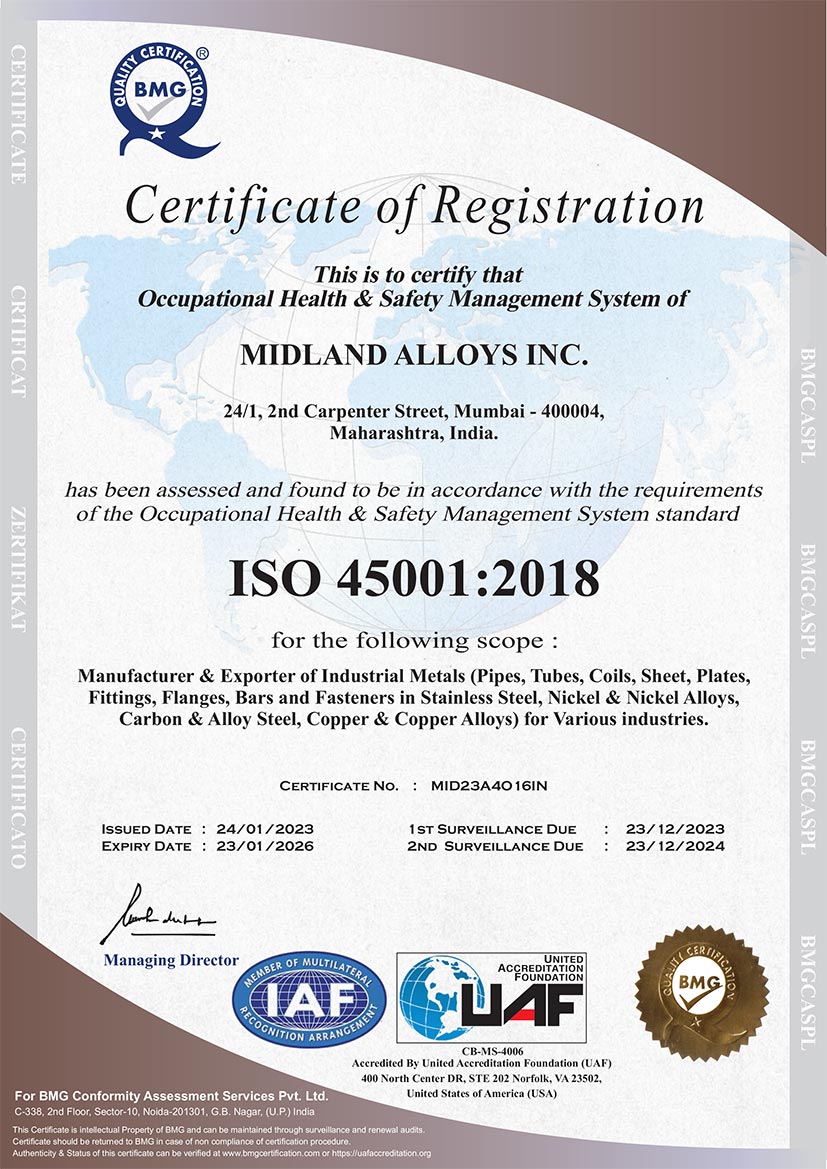
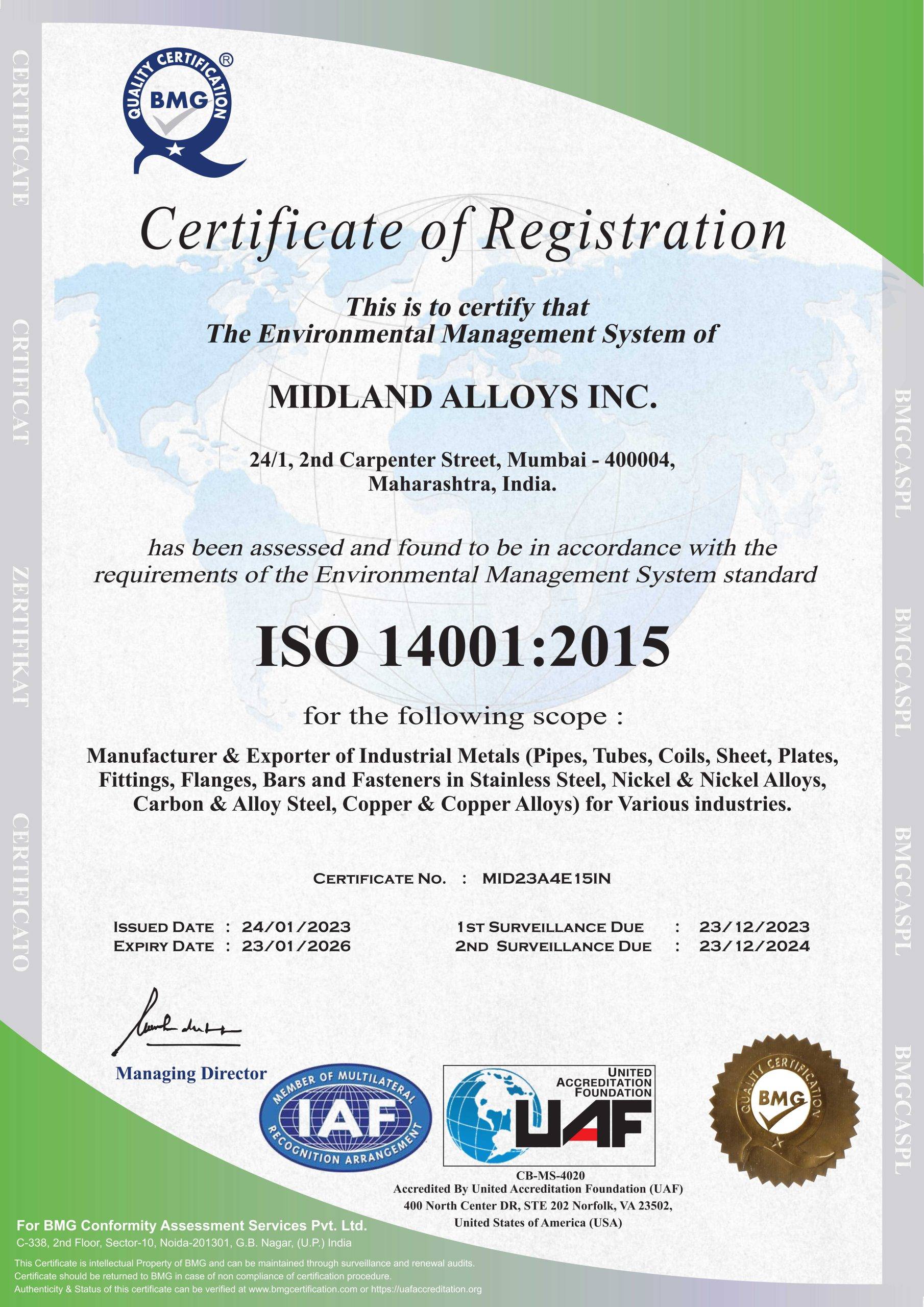
Stainless Steel 316/316L pipes are top-notch austenitic alloys designed to perform reliably in environments rich in chlorides and at elevated temperatures. They’re well known for their outstanding resistance to pitting and crevice corrosion, making them perfect for marine, chemical, oil & gas, pharmaceutical, and food-grade piping systems. Due to its low carbon content, SS 316L has excellent weldability and reduces the possibility of carbide precipitation during high temperature fabrication. Midland Alloys Inc. takes pride in producing and supplying seamless, welded, ERW and EFW stainless steel 316 pipes while closely adhering to ASTM A312, A213, and A269 standards. Being a reputable SS 316 pipe manufacturer in India we can meet the needs of both domestic and foreign projects by providing bulk stock exact tolerances and custom cut lengths.
Stainless Steel 316/316L Pipes

What Are Stainless Steel 316 and 316L Pipes?

The austenitic 300 series stainless steel family which includes stainless steel 316 and 316L is made for applications requiring a high level of chemical stability and corrosion resistance. These alloys function well in harsh environments especially those that are acidic or chloride-rich. Chromium (Cr), nickel (Ni) and molybdenum (Mo) make the chemical base of SS 316 molybdenum is the essential component that improves resistance to pitting and crevice corrosion. 

The carbon content is the primary distinction between 316 and 316L stainless steel. Because SS 316 has about 0.08% carbon it has superior tensile strength and creep resistance at high temperatures. The low carbon stainless steel pipe variety SS 316L on the other hand has a maximum carbon content of 0.03% which greatly enhances weldability and inhibits carbide precipitation during the welding process. Both grades can be used in a variety of pressure and process systems where corrosion control and structural performance are crucial because they offer seamless and welded forms.

Specification of 316/316L Stainless Pipe

Key Advantages of Stainless Steel 316/316L Pipes

Long-Term Durability in Harsh Conditions
Both SS 316 and 316L offer outstanding resistance to corrosive environments making it dependable for systems exposed to fluctuating pressures and moderate heat. This stability ensures a longer service life with minimal maintenance.

Resistance to Process-Induced Contamination
The non-reactive, smooth surface finish of these grades prevents material shedding and chemical interaction, helping maintain purity in process lines. This benefit is especially critical where contamination control is a top priority.

High Weld-Integrity Performance
One of the most important benefits of 316L stainless steel is its low carbon content, which prevents weld decay and intergranular corrosion. This makes it ideal for welding-intensive fabrication, producing strong, clean welds without the need for post-weld heat treatment.

Dimensional Stability Under Load
Even after extended exposure to load-bearing conditions, both grades retain exceptional mechanical strength and shape retention. They are reliable high temperature stainless steel pipe material because of their ability to function in supporting roles or structural lines under pressure.

Custom Fabrication Suitability
These alloys adapt well to cutting, forming, machining and bending, without cracking or fatigue. SS 316 pipe’s ability to be easily integrated into intricate assemblies makes it perfect for precision builds that require each component to be strong and resistant to corrosion.

SS 316/316L vs Other Stainless Steel Grades

SS 316 and 316L are widely preferred over many stainless steel grades because of their molybdenum content, which significantly improves resistance to chlorides and harsh corrosive agents. This advantage makes them dependable choices in aggressive environments where standard austenitic grades may not hold up.

Compared to SS 304, which is more economical and readily available, 316/316L offers superior protection against pitting and chemical attack—particularly in marine or chloride-exposed conditions. While 304 may suffice in general-use applications, it lacks the enhanced durability that 316-grade alloys provide in corrosive media.

SS 310 performs better at elevated temperatures due to its high oxidation resistance, but it doesn’t match 316/316L’s corrosion performance in moisture-rich or acidic surroundings. In contrast, 316Ti improves thermal stability through titanium stabilization, but 316L remains easier to weld and fabricate without the risk of sensitisation.

On the duplex side, Duplex 2205 delivers greater mechanical strength and stress resistance but tends to be less ductile than 316L and more challenging to work with during forming or welding.

Specification of 316/316L Stainless Pipe

Stainless Steel 316/316L pipes are manufactured to ASTM A312, ASTM A213, ASTM A269, and ASTM A249 standards, ensuring reliable performance in pressure-rated and structural piping applications. To satisfy a range of fabrication and service needs, these pipes are offered in seamless, welded, ERW and EFW varieties. They facilitate precise fitment and project specific design flexibility with a broad range of schedules (SCH 5 to SCH 160), end types (plain, beveled and threaded) and cut to length options.

Finish
Sizes in Stock

Seamless Pipe OD : 1/8 -12" NPS
Welded Pipe OD : 6.35 to 114.3 mm
EFW Pipe Size : 6″ NB – 24″ NB

ASTM Standard
Standard

ASTM A312, ASTM A213, ASTM A269, ASTM A249

Process
Manufacturing Process

Seamless, ERW, Welded, Fabricated

Form
Form

Round, Square, Rectangular, Hydraulic Etc

Length
Length

Single Random, Double Random & Cut Length.

End Icon
End

Plain End, Beveled End, Treaded

Schedule
Schedule

SCH5, SCH10, SCH20, SCH30, SCH40, STD, SCH80, SCH 80S, SCH60, SCH80, SCH120, SCH140, SCH160, SCH XXS, SCH XS

Finish
Surface Finish

No. 2B - Mill finish/ Matte finish, No.8 - Mirror finish, No. 4 - Brushed finish, Bright, Annealing, Polished, Mirror

Types of SS 316/316L Pipes

Stainless Steel 316/316L pipes are manufactured in multiple forms to meet varying demands for corrosion resistance, mechanical strength and operating pressure.

Manufacturing Types

  • Seamless Pipe
    Seamless Pipe

    Manufactured without welds, SS 316/316L seamless pipes are ideal for high-pressure, precision-demanding environments where uniform strength is essential.

  • Welded Pipe
    Welded Pipe

    Welded pipes which are made by joining strips of stainless steel, are an affordable choice for systems with moderate pressure and consistent resistance to corrosion.

  • ERW (Electric Resistance Welded) Pipe
    ERW (Electric Resistance Welded) Pipe

    Electric resistance welding is used to create ERW 316 stainless steel pipes which are appropriate for light mechanical and structural uses.

  • EFW (Electric Fusion Welded) Pipe
    EFW (Electric Fusion Welded) Pipe

    EFW pipes, which have smooth interiors and strength for fluid handling, are utilized in large-diameter piping for process industries.

Pipe Forms

  • Round Pipe
    Round Pipe

    Round SS 316 pipes are the most common form, designed for efficient and clean fluid or gas transport in piping networks.

  • Square Pipe
    Square Pipe

    Strength and symmetry are combined in SS 316 square pipes which are frequently utilized in visible pipeline designs and structural frameworks.

  • Rectangular Pipe
    Rectangular Pipe

    These pipes are valued for their flat-sided design, ideal in structural systems where load distribution and aesthetic matter.

  • Hydraulic Pipe
    Hydraulic Pipe

    Tight dimensional control in hydraulic stainless steel pipes guarantees steady flow and pressure in high-performance fluid systems.

Contact Midland Alloys Inc. for Your Stainless Steel 316 Pipes Needs

Contact us today to discuss how Stainless Steel 316/316L Pipes can benefit your application. Whether you need guidance in selecting the right pipes or have specific requirements, our team of experts is here to help you find the optimal solution.

Technical Details & Delivery Condition

SS 316 and SS 316L are austenitic stainless steels formulated with controlled chemical compositions that directly influence their corrosion resistance, mechanical behaviour, and fabrication characteristics. These elements define how the material performs in demanding environments.

The main difference is the carbon content: SS 316L has a carbon content of only 0.03% whereas SS 316 phas up to 0.08% greatly lowering the possibility of carbide precipitation during welding.

GradeUNS NoCMnPSSiCrNiMo
TP316S316000.082.000.0450.0301.0016.0 – 18.010.0 – 14.02.00 – 3.00
TP316LS316030.0302.000.0450.0301.0016.0 – 18.010.0 – 14.02.00 – 3.00


Ensuring dependable performance under load bearing, pressure-rated and structural conditions, ASTM A312 and associated material standards define the mechanical properties of SS 316 and 316L pipes. The appropriateness of the pipe in settings with mechanical stress, internal pressure, and external loads is determined in part by these specifications.

With a slight variation caused by the carbon content, SS 316 and 316L have strength levels that are almost identical. Due to its higher carbon content, SS 316 provides marginally better creep resistance at higher temperatures; however for stress sensitive designs, SS 316L maintains excellent tensile and yield strength while enhancing weld integrity.

GradeTensile Strength (MPa) minYield Strength 0.2% Proof (MPa) minElongation (% in 50mm) minHardness Rockwell B (HR B) maxHardness Brinell (HB) max
3165152054095217
316L4851704095217

The international recognition of stainless steel 316 and 316L under a variety of material designations aids procurement teams and engineers in ensuring cross standard compatibility. These equivalent grades enable smooth material selection in differeny country projects because they meet with major international specifications like UNS, EN, DIN, JIS and others.

GradeUNS NoJapanese JISEuronorm NoEuronorm NameOld British BSOld British EnSwedish SS
316S31600SUS 3161.4301X5CrNi18-10304S3158E2332
316LS31603SUS 316L1.4404X2CrNiMo18-10304S5158L2333

Why 316/316L Performs in Corrosive Environments

Because of their molybdenum enriched chemistry stainless steel 316 and 316L which belong to the austenitic stainless steel family are designed to have improved corrosion resistance. The passive chromium oxide layer that naturally develops on the metal surface is greatly strengthened by the presence of molybdenum serving as a defence against aggressive chemical attack. This passive film shields the alloy from pitting and crevice corrosion in corrosive environments especially when chlorides, brine, acidic compounds and moist industrial atmospheres are present. This film’s stability allows it to regenerate even in the event of mechanical damage providing ongoing protection for extended periods of time.

SS 316L with its low carbon content, prevents sensitisation and intergranular corrosion following welding or prolonged heat exposure. This feature makes 316L especially effective for welded process systems that must endure corrosive flow media without post-weld heat treatment or risk of internal attack along grain boundaries. Because of this combined behaviour, molybdenum induced passivation and resistance to thermal sensitisation SS 316/316L pipes perform reliably in environments that challenge most metals.

Stainless Steel Pipe Grades We Also Offer

Price of SS 316/316L Pipe per Kg in India

We offer SS 316 and 316L pipes at competitive prices across India, with a strong supply network for domestic and export orders. The ss 316 pipe price per kg in India generally falls between ₹420 to ₹640, influenced by factors such as whether the pipe is seamless or welded, its schedule (thickness), diameter, and required surface finish. Typically, the 316L stainless steel pipe price is slightly higher than 316 due to its low carbon content, which benefits welded systems by minimising sensitisation. The 316 vs 316L pipe price difference becomes more relevant in fabrication-heavy or corrosion-sensitive projects. We provide mill test certification, cut-to-length options, and bulk pricing for large industrial orders, with final pricing based on size, quantity, and current raw material costs.

How SS 316/316L Pipes Are Manufactured

The SS 316 pipe manufacturing process involves two main techniques: seamless and welded, selected based on pressure ratings, dimensional tolerances, and end-use conditions. The base of seamless pipes is a solid billet of stainless steel that is heated and pierced into a hollow tube using rotary piercing or extrusion equipment. After that the wall thickness and diameter are refined to meet the necessary specifications by rolling, sizing, and annealing

When it comes to welded pipes, techniques like electric resistance welding (ERW) and electric fusion welding (EFW) are used to form flat-rolled stainless steel strips or plates into cylindrical shapes and join them longitudinally. Depending on the hygienic needs of the application or the desired surface finish the seam is heat-treated after welding and may then be pickled or polished.

Annealing minimizes internal stress and increases corrosion resistance in 316/316L pipes whether they are seamless or welded. To guarantee complete compliance with ASTM A312 and other pertinent standards, pipes undergo surface inspection, non destructive testing (NDT) such as radiography or ultrasonic examination and dimensional accuracy checks prior to dispatch.

Round Bar

Round Bar

arrow
Analytic

Analytic

arrow
Cut to Length

Cut to Length

arrow
Centering

Centering

arrow
Heating

Heating

arrow
Perforation

Perforation

arrow
Inspection of Size

Inspection of Size

arrow
Pickling

Pickling

arrow
Inspection of Surface

Inspection of Surface

arrow
Lubricating

Lubricating

arrow
Cold Drawing (Cold Rolling)

Cold Drawing (Cold Rolling)

arrow
Degreasing

Degreasing

arrow
Annealing

Annealing

arrow
Straightening

Straightening

arrow
Cut

Cut

arrow
Pickling / Passivating

Pickling / Passivating

arrow
Inspection

Inspection

arrow
Analytic

Analytic

arrow
Marking

Marking

arrow
Packing & Shipping

Packing & Shipping

Applications of SS 316/316L Pipes

As a trustworthy supplier of SS 316 pipe in India, Midland Alloys Inc. is distinguished by its reliable quality, timely delivery and customer focused philosophy. As a certified manufacturer of 316L pipes we deliver products with complete traceability and documentation while closely adhering to international standards like ASTM A312 and ASME SA312. In order to guarantee adherence to project-specific specifications, clients are provided with mill test certificates (EN 10204 3.1) and the opportunity for third party inspection by reputable organizations such as TUV, BV or DNV. Structural applications like boiler tubes, condensers and pressure vessels also benefit from their high mechanical stability. 316L pipes with their low carbon content, are especially preferred for welded assemblies as they minimise the risk of intergranular corrosion without requiring post-weld heat treatment. 

Why Choose Midland Alloys Inc. for SS 316/316L Pipes

As a trustworthy supplier of SS 316 pipe in India, known for our reliable quality, timely delivery, and customer-focused philosophy. As a certified manufacturer of 316L pipes the business delivers products with complete traceability and documentation while closely adhering to international standards like ASTM A312 and ASME SA312. In order to guarantee adherence to project-specific specifications, clients are provided with mill test certificates (EN 10204 3.1) and the opportunity for third-party inspection by reputable organizations such as TUV, BV, or DNV.

We maintain a strong inventory of stainless steel pipe stock, including custom lengths, mirror or polished finishes and cut-to-length options to support both routine and urgent procurement needs. As experienced stainless steel pipe exporters, Midland efficiently handles global shipments with logistics coverage across the Gulf, Europe, and Southeast Asia, offering secure packing and export documentation.

With a focus on competitive pricing, fast response times, and reliable customer service, Midland Alloys Inc. continues to build long-standing partnerships with industrial buyers worldwide as a certified SS pipe supplier.

FAQs – SS 316/316L Pipes

Yes, SS 316/316L pipes perform exceptionally well in marine and coastal environments due to their molybdenum-enhanced corrosion resistance, which helps prevent pitting and crevice corrosion caused by chlorides in seawater.

Absolutely. These pipes are manufactured as per ASTM A312, ASTM A213, and ASTM A269 standards, and are available with EN 10204 3.1 mill test certificates and optional third-party inspections (TUV, BV, DNV), ensuring full global compliance.

The pressure rating depends on pipe size, schedule (wall thickness), and temperature, but SS 316/316L pipes can typically withstand pressures up to 6000 psi or more in high-schedule seamless configurations. 

Yes. SS 316L offers superior chloride resistance compared to SS 304L, making it the preferred choice for coastal construction, seawater pipelines, and outdoor structural applications where salt-laden air is present.

Quick Quote Request

Our experts will get back within 24 hrs.