Pipe selection shapes everything downstream: pressure ratings, fabrication costs, lead times, and how the installed system holds up over its design life. Get it wrong and you either over-specify and waste budget, or under-specify and deal with failures at the worst possible moment. Seamless stainless steel pipe and welded stainless steel pipe both serve critical industrial roles but they’re not interchangeable, and treating them that way is where most procurement errors begin.
What Are Seamless Stainless Steel Pipes?
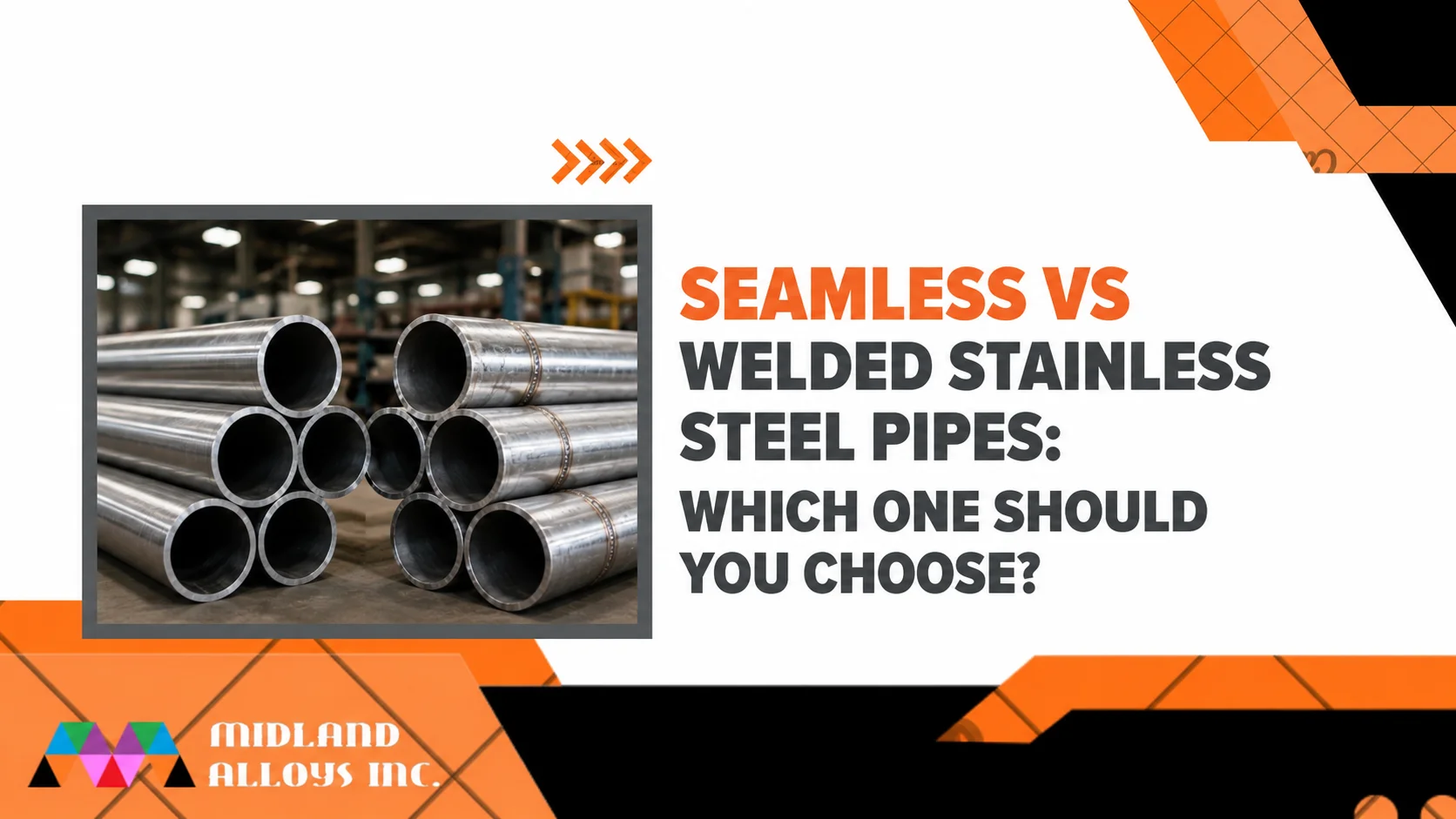
Seamless pipes start as a solid stainless steel billet. The billet gets heated, then pierced and extruded through a die to form the hollow tube. No welding. No seam. The result carries consistent mechanical properties across the full cross-section: there’s no weld zone, no heat-affected area, and no seam that could become a pressure or corrosion weak point.
ASTM A312 covers seamless stainless steel pipe in grades 304/304L, 316/316L, 321, and others for pressure applications. ASTM A213 covers seamless tubing for heat exchangers and boilers. Both require full-length hydrostatic testing or non-destructive examination as standard.
Key Features of Seamless Pipes
• No welded seam uniform structure eliminates weld zone as a potential failure point
• High pressure and temperature resistance wall integrity holds at operating conditions that exceed welded pipe limits
• Uniform mechanical properties consistent yield and tensile strength across the full pipe cross-section
• Excellent structural integrity preferred for safety-critical and code-stamped applications
• Available in smaller to medium diameters standard range from 1/8″NPS to 24″NPS in most grades
Advantages of Seamless Pipes
Superior Strength
No seam means no localized strength reduction. In high-cycle pressure service compressor discharge lines, reactor inlet piping, wellhead connections the pipe sustains repeated pressure loading without the stress concentration at a seam weld that could initiate fatigue cracking. That structural consistency matters most in Schedule 80 and heavier wall applications.
Better Pressure Handling
Rated working pressure for seamless pipe runs higher than welded at the same nominal dimensions. ASME B31.3 process piping calculations apply a weld joint quality factor to welded pipe that reduces its allowable pressure; no such derating applies to seamless. In high-pressure gas service above 600 PSI, that difference determines which pipe type makes it onto the material requisition.
Enhanced Reliability
Nuclear, offshore, and critical chemical process specifications routinely mandate seamless construction. It’s not overspecification in those contexts; it reflects the cost consequence of in-service failure. Mean time between replacement runs longer with seamless in abrasive or chemically active fluid service because there’s no weld seam to corrode preferentially.
What is a Welded Stainless Steel Pipe?
The welded pipe starts flat. Stainless steel strip or coil rolls into a cylinder, and the edges fuse through either electric resistance welding (ERW/EFW) or TIG welding depending on wall thickness and specification. The seam undergoes radiographic or ultrasonic inspection to confirm weld integrity before the pipe ships. ASTM A312 covers welded and seamless in the same standard the key distinction appears in the product designator (WP for welded, S for seamless) and the weld examination requirement.
Key Features of Welded Pipes
• Manufactured from stainless steel sheets or coils starting material is more available and less expensive than billet
• Available in a wide range of diameters and wall thicknesses production flexibility extends to large diameters not achievable seamlessly
• Cost-effective production process fewer processing steps reduce unit cost by 20–40% vs seamless for the same size
• Suitable for low to medium pressure applications covers the majority of industrial system requirements
Advantages of Welded Pipes
Welded pipes provide exceptional value by offering a highly efficient, versatile, and economical solution for modern industrial fluid transport networks.
Lower Cost
Produced from flat steel strips, these pipes involve fewer manufacturing steps, typically costing 25% to 35% less than seamless alternatives.
Greater Size Availability
Large-diameter pipes above 24 inches are commercially practical only as welded, since seamless production at these sizes is completely unavailable.
Faster Production
Standard sizes ship quickly from stock, while custom large-diameter orders deliver in just weeks compared to months for seamless pipes.
Larger Diameter Production Capability
Advanced LSAW and SSAW welding processes easily manufacture ultra-large pipes up to 72 inches for major transmission and structural applications.
Suitable for Most Systems
Commercial HVAC, food processing, and water facilities easily run at operating pressures well within the certified limits of welded piping.
Applications
These reliable pipes serve various critical functions across municipal infrastructure, sanitary processing, and modern architectural design.
Water Distribution Systems
Corrosion-resistant 304 and 316 grades securely manage municipal and industrial water main networks.
Food Processing Equipment
Hygienic 304L pipes feature a polished bore finish to ensure clean, sanitary fluid transfer.
Pharmaceutical Industries
High-purity, electropolished 316L lines safely handle critical clean-in-place and water-for-injection distribution systems.
Structural Applications
These strong profiles provide clean aesthetics for exposed architectural piping, handrails, and building facades.
HVAC Systems
Durable piping efficiently supports low-pressure chiller lines, ductwork, and outdoor cooling tower connections.
Decorative and Architectural Projects
A consistent, high-quality surface finish makes these welded pipes perfect for highly visible installations.
Stainless Steel Pipe Seamless vs Welded: Key Differences That Affect Performance
The table below covers the performance and procurement differences that affect which pipe type belongs on a project specification.
| Property | Seamless Pipe | Welded Pipe |
| Production method | Extruded from solid billet | Rolled from sheet/coil and seam-welded |
| Pressure rating | Higher no seam limitation | Moderate depends on weld quality |
| Diameter range | Typically up to 24″NPS | Up to 72″NPS and beyond |
| Wall uniformity | Consistent throughout | Consistent except at weld zone |
| Cost | Higher more material and process steps | Lower faster, less material waste |
| Lead time | Longer for non-stocked sizes | Shorter for standard sizes |
| NDT requirement | Standard per ASTM A312 | Weld seam NDT mandatory |
| Typical standard | ASTM A312, A269, A213 | ASTM A312, A778, A249 |
| Primary applications | Oil & gas, nuclear, critical pressure service | HVAC, food, pharma, construction, water |
Which Stainless Steel Pipe Should You Choose?
Choose Seamless Pipes When:
• Operating under high pressure above 600 PSI service pressure where the ASME weld quality factor derating of welded pipe matters
• Working with extreme temperatures cyclic thermal loading above 400°C where weld zone fatigue behavior differs from base material
• Meeting strict industry specifications nuclear, subsea, and critical chemical process standards mandate seamless construction
• Safety is the highest priority when in-service failure consequence justifies the higher material cost
Choose Welded Pipes When:
• Cost optimization is important budget-driven projects where the pressure rating of welded pipe is sufficient for the service
• Large diameters are required 24″NPS and above where seamless production isn’t commercially available
• Moderate pressure conditions exist HVAC, water, food, and pharmaceutical systems that operate below 300 PSI
• Fast project delivery is needed standard welded sizes available ex-stock vs longer seamless lead times for non-stocked dimensions
Midland Alloys Inc. offers stainless steel seamless and welded pipe in 304/304L, 316/316L, 321 and 310S (ASTM A312, A269 and A213) with complete mill certification and same week shipping on standard sizes. Contact us for size and grade availability prior to finalizing your pipe specification.