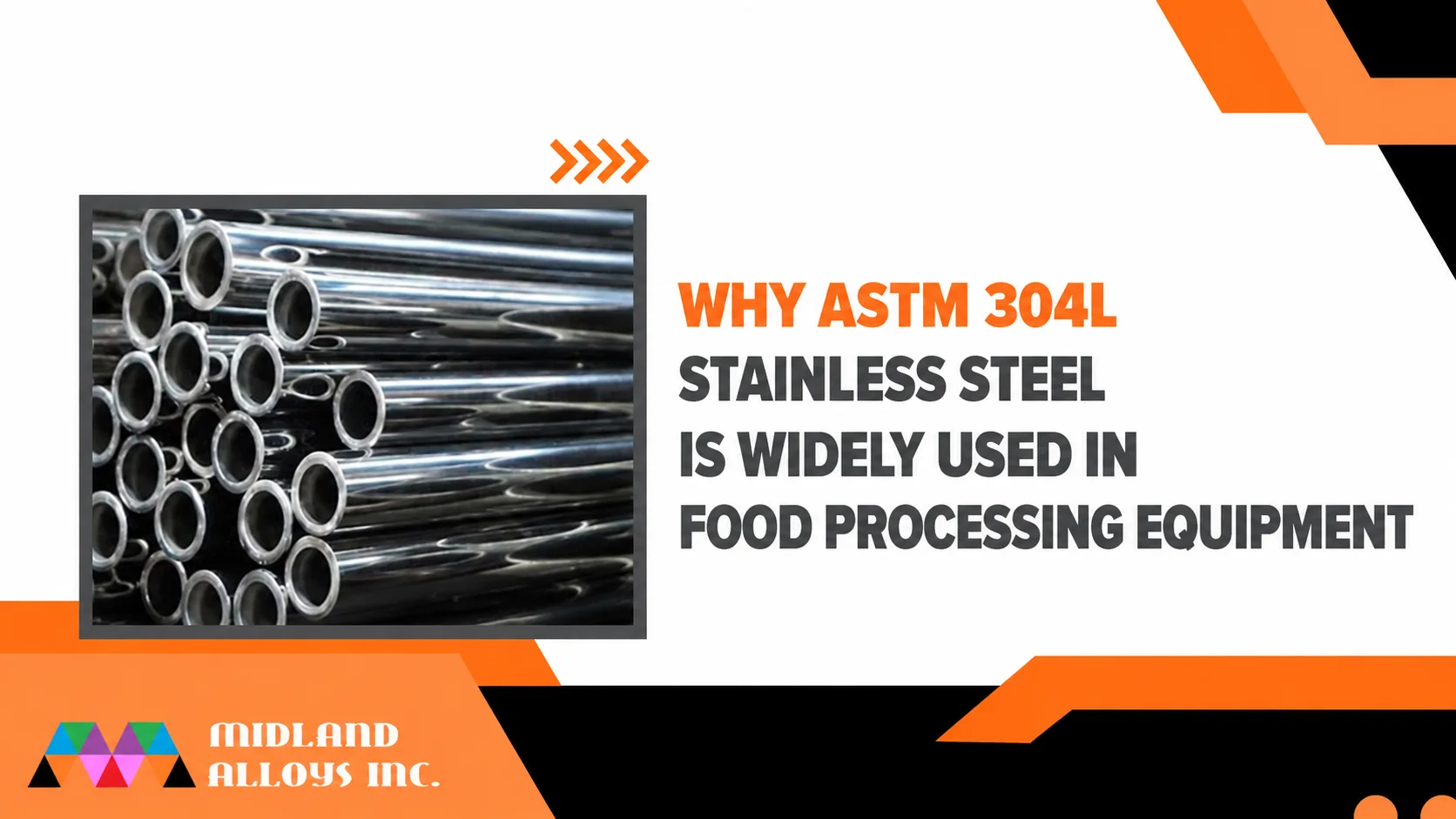
Food processing equipment requires materials that are corrosion resistant, easy to clean, and durable in the face of continual washdown. Austenitic stainless steel, specifically ASTM 304L stainless steel, remains the most specified austenitic grade for hygienic applications. Its low carbon content maintains weld integrity, and its chromium-nickel make up provides resistance to the acids and cleaning solutions used in dairy and beverage industries. In this blog we discuss the properties, uses and selection considerations of stainless steel for use in process equipment, piping and storage.
What Is ASTM 304L Stainless Steel?
ASTM 304L Stainelss Steel is a standard 304 stainless steel and low in carbon content of maximum 0.03% compared to 0.08% in 304. This limits carbide precipitation at the weld zone, which lowers the risk of intergranular corrosion after fabrication. The alloy carries roughly 18 percent chromium and 8 percent nickel, giving strong resistance to oxidation. Processors commonly source 304L stainless steel tubes for hygienic, corrosion-sensitive applications.
Why Material Selection Is Critical in Food Processing Equipment
Choice of material is a direct food safety factor. Equipment madeup of surfaces that sum of cracks or pit, or corrodes, harbours spaces where bacteria hide, and that risk is multiplied with every contact with food acids or cleaning solutions. Stainless steel is also smooth and non-porous allowing for clean sanitation between runs of production. It also meets regulations such as the FDA, 3-A Sanitary Standards and withstands years of continuous use.
Key Properties of ASTM 304L Stainless Steel That Benefit Food Processing
Five properties make this grade suit hygienic processing environments.
Excellent Corrosion Resistance
304L resists staining and pitting from moisture, food acids, and salt exposure. This holds even in areas that stay damp between shifts.
Superior Weldability
Low carbon content limits carbide precipitation during welding, protecting weld seams. Fabricators use this grade for tanks and piping without post-weld treatment.
Hygienic and Easy-to-Clean Surface
The surface finish stays smooth and non-porous, leaving no crevices for bacteria. Cleaning crews wipe down equipment without scrubbing into pitted areas.
Good Mechanical Strength
This grade holds up under vibration, pressure cycling, and physical loads in production lines. Framing and tanks keep their shape for years.
High Temperature and Chemical Resistance
304L handles intermittent exposure to temperatures near 870°C without significant scaling. It also tolerates caustic and acidic cleaning agents used in CIP systems.
Common Food Processing Equipment Manufactured Using ASTM 304L Stainless Steel
Six equipment categories rely on this grade across processing plants.
Food Processing Pipelines
Pipelines carrying liquids or CIP fluids need a smooth bore to avoid buildup. 304L resists corrosion along weld joints during cleaning.
Mixing & Storage Tanks
Tanks holding ingredients or finished product need welded seams that resist corrosion. 304L plate fabricates into tanks without weld decay affecting storage.
Heat Exchangers
Heat exchangers cycle between hot and cold service, stressing welded joints repeatedly. 304L tubing handles this cycling while resisting fouling on interior surfaces.
Dairy Processing Equipment
Dairy lines process milk and cultured products that are mildly acidic and need frequent washdown. 304L surfaces tolerate this acid exposure without pitting.
Beverage Production Systems
Beverage systems handle carbonation, sugar syrups, and acidic juices across bottling and blending. 304L piping resists this acid exposure across long production runs.
Commercial Kitchen Equipment
Commercial kitchens use 304L for worktables, sinks, and prep surfaces needing daily sanitizing. The grade holds up under constant contact with food and cleaning solutions.
Benefits of ASTM 304L Stainless Steel in Food Processing Plants
Food processing plants that switch to 304L equipment see fewer contamination incidents tied to pitted surfaces. The material’s weldability simplifies fabrication of tanks and piping, and its corrosion resistance keeps maintenance schedules light.
| Property | Benefit in Food Processing |
| Corrosion Resistance | Longer equipment life |
| Low Carbon Content | Better weld quality |
| Smooth Surface | Easy cleaning and sanitation |
| Excellent Weldability | Simplifies fabrication |
| Mechanical Strength | Reliable operation |
| Durability | Lower maintenance costs |
ASTM 304L Stainless Steel vs ASTM 316L Stainless Steel for Food Processing
304L and 316L share similar weldability, but 316L adds molybdenum for better resistance in high-chloride environments such as coastal plants. For standard food and beverage processing away from heavy chloride exposure, 304L delivers comparable corrosion resistance at a lower cost. Processors near saltwater exposure often move to 316L.
| Feature | ASTM 304L Stainless Steel | ASTM 316L Stainless Steel |
| Corrosion Resistance | Excellent | Superior, especially in chloride environments |
| Weldability | Excellent | Excellent |
| Cost | More economical | Higher |
| Typical Food Applications | General food and beverage processing | Marine food processing and high-chloride environments |
| Best Choice | Standard food processing | Highly corrosive processing environments |
Factors to Consider When Selecting ASTM 304L Stainless Steel
Selection depends on the food or beverage being processed, since some products carry higher acid content. Exposure to cleaning chemicals, temperature, and welding requirements affect wall thickness and tube dimensions. Applicable food safety regulations also narrow the choice. Source certified material with mill test reports.
Why Choose Midland Alloys for ASTM 304L Stainless Steel Tubes?
Midland Alloys supplies tested and certified ASTM 304L stainless steel tubes for food processing and industrial applications, with technical support available for tube dimensions, wall thickness, and delivery timelines.
Conclusion
ASTM 304L stainless steel is a widely used food grade for food processing equipment due to its corrosion resistance, weld quality, and hygiene surface quality post fabrication. Selecting the proper grade supports food safety and helps reduce long-term maintenance.
For specifications, sizes, and standards for food processing and industrial applications, explore Midland Alloys’ ASTM 304L Stainless Steel Tubes.