Introduction
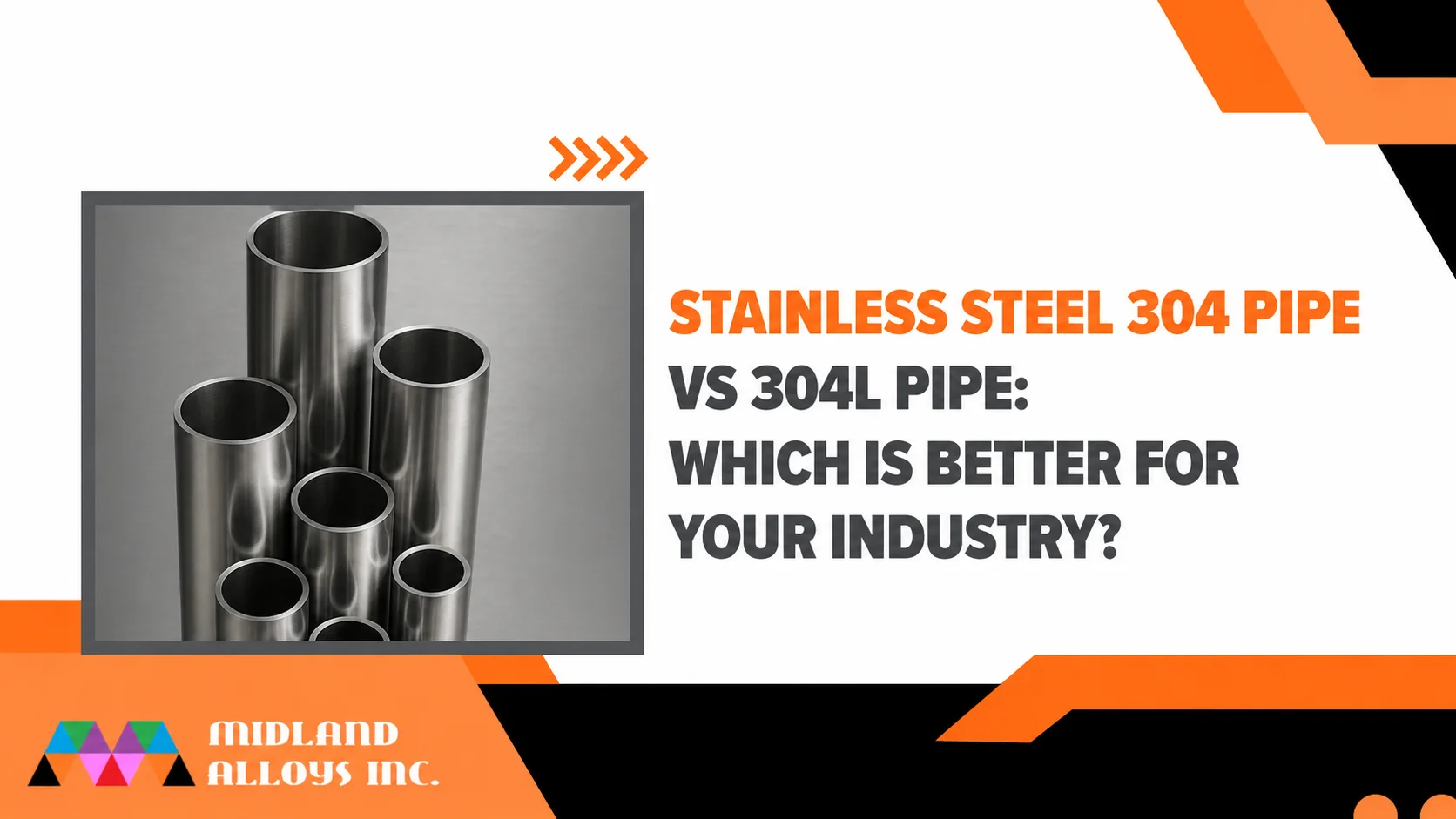
Stainless steel 304 pipe and stainless steel 304L pipe rank among the most specified austenitic grades in industrial piping, and both resist corrosion well and hold up to years of demanding service. The difference between them comes down to carbon content, weldability, and how each performs once fabrication is complete. Choosing the right grade depends less on personal preference and more on your fabrication method, operating environment, and industry requirements. This guide compares 304 and 304L pipe side by side so buyers, engineers, and fabricators can make a material selection that fits the application.
What Are Stainless Steel 304 and 304L Pipes?
Stainless Steel 304 pipe is a standard austenitic grade, part of the broader 18-8 chromium-nickel family, known for solid mechanical strength and dependable corrosion resistance across general industrial use. Stainless Steel 304L pipe belongs to the same family, but with one key change: a lower carbon content, capped at roughly 0.03% compared to 304’s higher allowance.
That lower carbon content is the primary reason 304L was developed. Lower carbon reduces the risk of carbide precipitation during welding, which keeps corrosion resistance intact near the weld zone. Both grades fabricate well and machine cleanly, so the choice usually comes down to how much welding a project involves.
Stainless Steel 304 Pipe vs 304L Pipe: Key Differences
| Property | Stainless Steel 304 Pipe | Stainless Steel 304L Pipe |
| Carbon Content | Higher | Lower |
| Weldability | Excellent | Superior |
| Corrosion Resistance After Welding | Good | Better |
| Heat Treatment Requirement | May be required after welding | Usually not required |
| Strength | Slightly higher | Slightly lower |
| Fabrication | Excellent | Excellent |
| Best Applications | General industrial use | Welded and corrosive applications |
Chemical Composition Comparison
The carbon content is where these two grades really part ways. Standard 304 allows carbon up to about 0.08%, while 304L caps it near 0.03%. Chromium (roughly 18%) and nickel (roughly 8%) stay largely consistent across both grades, which is why corrosion resistance and ductility remain comparable overall.
That small carbon difference has an outsized effect during welding. Higher carbon content in standard 304 encourages chromium carbides to form along grain boundaries in the heat-affected zone, a process called sensitization. 304L’s reduced carbon minimizes that carbide precipitation, which is exactly why it holds up better in welded, corrosion-exposed service.
Mechanical Properties Comparison
| Mechanical Property | 304 Pipe | 304L Pipe |
| Tensile Strength | Excellent | Excellent |
| Yield Strength | Slightly higher | Slightly lower |
| Ductility | Excellent | Excellent |
| Toughness | Excellent | Excellent |
| Weldability | Excellent | Superior |
Both grades deliver strong tensile performance and hold their toughness across a wide temperature range, so neither one is the weak link mechanically. The gap in yield strength between them is minor and rarely decides a project on its own. Where the two genuinely diverge is weldability: 304L’s lower carbon content makes it the more forgiving choice for extensive weld work.
Corrosion Resistance and Weldability Comparison
Corrosion Resistance
Both grades resist general corrosion well in moisture, mild chemical exposure, and typical atmospheric conditions. Standard 304 performs reliably in unwelded or lightly welded applications. 304L pulls ahead specifically after welding, where its lower carbon content prevents the carbide precipitation that would otherwise weaken corrosion resistance near the seam.
Weldability
Welding standard 304 pipe risks sensitization in the heat-affected zone unless post-weld heat treatment gets applied. 304L sidesteps that problem almost entirely, since there’s not enough carbon present to trigger significant carbide formation. That translates into fewer fabrication steps and more dependable corrosion performance right out of the welding booth.
Industrial Applications of Stainless Steel 304 and 304L Pipes
Food & Beverage Industry
Both grades see use here, but 304L is often preferred in welded process lines and tanks, since hygienic equipment can’t afford compromised corrosion resistance at the seams.
Pharmaceutical Industry
304L dominates in pharma piping, where extensive welding and strict cleanliness standards make post-weld corrosion resistance non-negotiable for product purity.
Chemical Processing Plants
304L handles welded piping exposed to corrosive chemicals better than standard 304, making it the safer default across most chemical process applications.
Water Treatment Systems
Standard 304 pipe often suits water treatment infrastructure well, particularly in sections with minimal welding where cost efficiency matters more than post-weld performance.
Oil & Gas Industry
Both grades find use depending on the specific system; 304L takes priority in heavily welded, corrosive service, while 304 fits structural and lower-exposure applications.
Architectural & Structural Applications
Standard 304 pipe is the common choice here, since structural work typically involves less welding and benefits from 304’s slightly higher strength.
When Should You Choose Stainless Steel 304 Pipe?
Standard 304 pipe is suitable for small welding operations. This versatile material can be used for a variety of industrial plumbing applications and inexpensive construction projects. It has higher mechanical strength than 304L and is reliable in moderate corrosive environments. Ultimately, Grade 304 is a cost-efficient material for building; therefore, it is useful for projects that don’t need to be heavily fabricated or have high corrosion resistance.
When Should You Choose Stainless Steel 304L Pipe?
304L pipe is the better fit whenever a project involves extensive welded fabrication. Chemical processing, corrosive environments, and hygienic process industries all benefit from 304L’s resistance to post-weld sensitization. Anywhere long-term corrosion resistance after welding matters more than a marginal strength advantage, 304L is the safer specification.
Factors to Consider Before Selecting 304 or 304L Pipe
| Selection Factor | Recommended Grade |
| Heavy Welding | 304L Pipe |
| General Industrial Use | 304 Pipe |
| Corrosive Environment | 304L Pipe |
| Structural Applications | 304 Pipe |
| Hygienic Processing | 304L Pipe |
| Budget-Focused Projects | 304 Pipe |
Welding requirements and corrosion exposure usually decide the grade first, followed by operating temperature and strength needs. Project budget matters too, since 304L typically costs a bit more than standard 304. Beyond the material itself, confirm your supplier certifies against relevant industry standards and backs every batch with proper quality assurance documentation.
Why Choose Midland Alloys for Stainless Steel 304 & 304L Pipes?
Midland Alloys manufactures the best grade 304 & 304L stainless steel seamless pipe to the most exacting ASTM and ASME specifications. Each batch is tested to our high standards of quality before it issued from our factory. We offer local and global customers reliable inventories, competent support with material selection and a variety of sizes and schedules to meet the needs of your project.
Conclusion
Stainless steel 304 and 304L pipe are both good in corrosion resistance and mechanical properties. There is not a “better” grade for everything; it depends on your welding requirements, the amount of corrosion you expect the weld to see, and the needs of your application. If you go for stainless-steel pipe with certification from a reputable provider, you are guaranteed consistent performance, durability, and longevity for your project. Searching for the best stainless steel pipe for your project? Before you decide, check out product options, sizes, timings, and technical details of Midland Alloys Stainless Steel 304 & 304L Seamless Pipes.