Every industrial piping system depends on its weakest connection point. Pipe fittings join, redirect, and terminate flow paths across refineries, power plants, and chemical units, and a poor choice at one joint can compromise an entire line. Among the many categories available, forged fittings and buttweld fittings dominate industrial specifications, but they solve different engineering problems.
This article compares forged and buttweld fittings across manufacturing, applications, advantages, and selection criteria. These fittings are often specified alongside pipes, flanges, and elbows within a single piping spec.
Understanding Forged Fittings and Buttweld Fittings
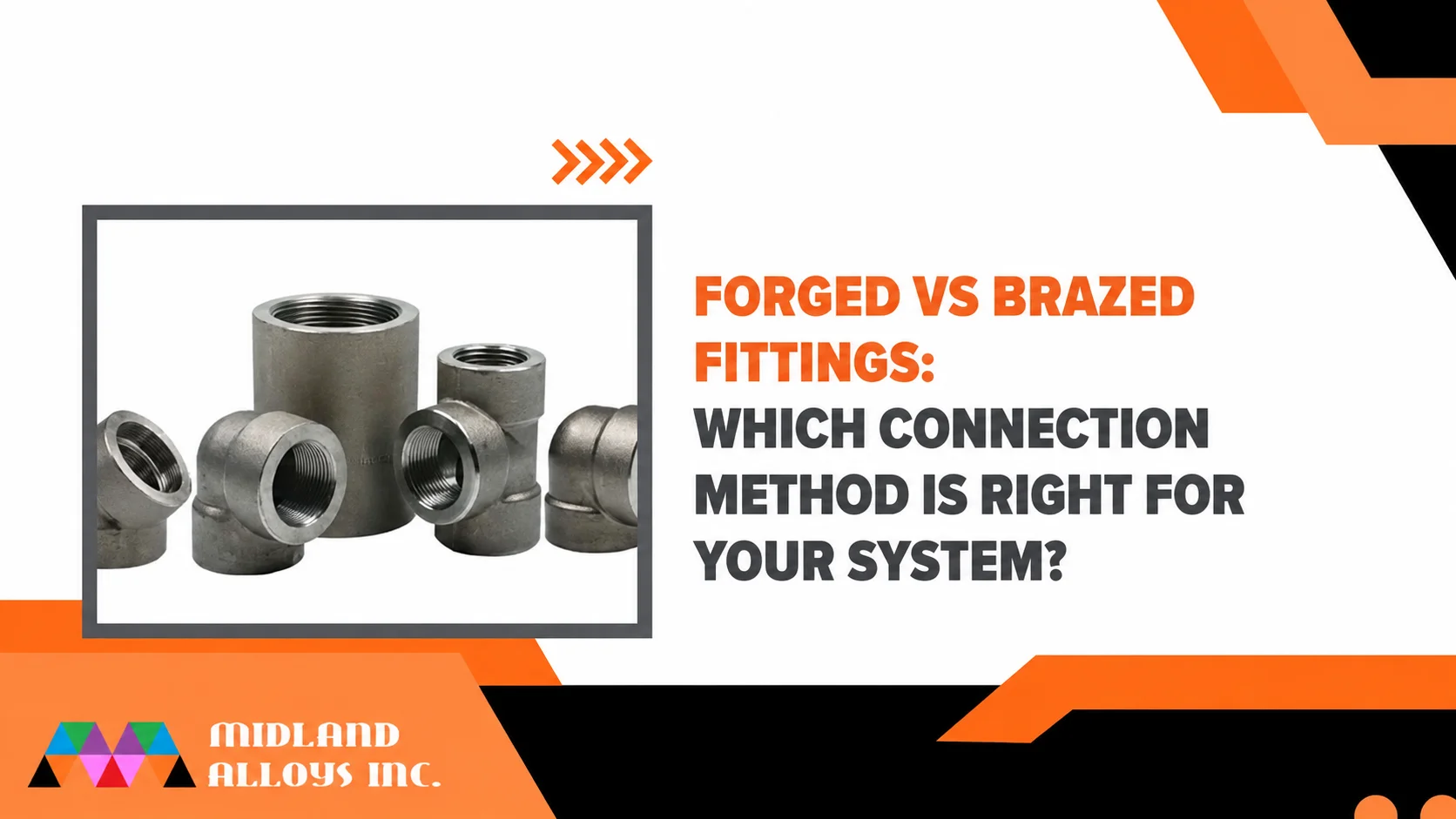
Forged fittings start as solid metal billets, shaped under compressive force into their final geometry. Forging aligns the metal’s grain structure, producing dense, defect-free material. Manufacturers rate them in pressure classes of 2000, 3000, 6000, and 9000. The two dominant types are socket weld fittings, inserted into a machined socket before welding, and threaded fittings, connected via NPT threads without welding. Carbon steel, stainless steel grades like 304 and 316, and alloy steel are common choices.
Buttweld fittings join two pipe ends directly, welded end to end with matching outer diameter and wall thickness. Manufacturers fabricate them from pipe or plate, complying with ASME B16.9 and MSS SP-43. Elbows, tees, reducers, caps, and stub ends make up the core range, available in schedules from 10 to XXS.
Forged vs Buttweld Fittings: Key Differences
Forging compresses metal into shape; buttweld fittings get formed and welded from plate or pipe stock, better suited to larger geometries. Connection method separates them further: forged fittings use socket weld fittings or threaded joints suited to smaller runs, while buttweld fittings connect only through full penetration welding, from 1/2 inch bore to 48 inches and beyond.
Forged fittings rarely exceed 4 inches NPS and excel in high-pressure, small-bore service at Class 6000 or 9000. Buttweld fittings match or exceed this at large bore, since wall thickness governs their rating. Socket weld and threaded joints install faster with less skilled labor; buttweld connections demand certified welders and radiographic testing. Buttweld’s smooth bore avoids the gap inherent in socket weld joints, a gap that traps fluid and invites crevice corrosion. Forged fittings cost less per unit at small diameters; buttweld becomes the only practical option at large diameters, with fewer leak points over its life and easier ultrasonic inspection.
Advantages of Forged and Buttweld Fittings
Forged fittings offer high mechanical strength, excellent pressure resistance and a compact design for congested layouts. They are reliable for small-bore piping and have a lower chance of material defects. They are suited for critical service applications in instrumentation and hydraulic lines.
Buttweld fittings are used to join two pipe ends together directly, with the welded ends abutting and having the same outer diameter and wall thickness. They are made by manufacturers from pipe or plate to ASME B16.9 and MSS SP-43. Elbows, tees, reducers, caps and stub ends in schedules 10 through XXS are covered in the basic range.
Applications
Forged fittings appear in oil and gas wellheads, petrochemical instrument connections, power plant lubrication circuits, hydraulic systems, and high-pressure utility lines, all sharing small bore size with high pressure.
Buttweld fittings dominate process piping in chemical plants and refineries, water treatment transmission mains, sanitary-grade food and beverage lines, and large-diameter industrial pipelines carrying crude, steam, or treated water.
Selection Criteria
Start with pipe size. Systems that are less than 2 inches tend to use forged fittings, while systems over 4 inches usually require buttweld construction. Check the operating pressure against the rated class of the fitting, and verify temperature suitability, as some alloys lose strength above 400°C. Where lines are viscous or contain particulates, flow requirements become important because of fouling in socket weld gaps. In remote locations, installation and maintenance factors, such as labor availability and inspection access, often decide the outcome. Confirm compliance with applicable ASME, ASTM, and MSS standards. Compare lifecycle value with initial cost.
Quick Selection Checklist: pipe size, pressure rating, temperature range, connection type, maintenance requirements, applicable standards.
Choosing a Reliable Pipe Fittings Supplier
A good pipe fittings supplier has the forged and buttweld ranges in different materials and schedules. Material traceability is important: every batch should be shipped with mill test certificates. For ASTM, ASME and MSS compliance, look for a full catalog with in-house quality testing, technical support on industrial pipe fittings selection and reliable inventory availability.
Conclusion
Forged fittings are the compact strength solution for small-bore, high pressure systems. Buttweld Fittings are suitable for large diameter piping systems, which require smooth flow and strong welded joints. They are not mutually exclusive. The right choice depends on pressure, size, installation conditions and the relevant standards.
Consult with a reliable pipe fittings supplier to find out what type of fitting will fit your piping specification.