Stainless steel piping systems carry corrosive chemicals, high-pressure steam, and food-grade liquids day in and day out. Every joint matters. If a connection fails under pressure, the whole line can go down, and that’s why SS Butt Weld Fittings get specified so often in industrial work. They join to the pipe through welding rather than threads or sockets, giving a connection that’s as strong as the pipe itself. This article walks through Stainless Steel Butt Weld Fittings and the factors that are important when specifying them. Also included are related items such as stainless steel pipes, pipe flanges and seamless pipe fittings that are used throughout industrial pipe fittings.
What Are SS Butt Weld Fittings?
A butt weld fitting joins pipe by welding rather than threading or socketing. The ends are beveled and aligned and then fused through the wall to make a continuous metal line. This gives pipe like strength, eliminates gaskets and threads and leaves a smooth bore. When done right, these fittings can last for decades. Typical grades are 304, 304L, 316, 316L and duplex alloys for more severe service.
Types of SS Butt Weld Fittings
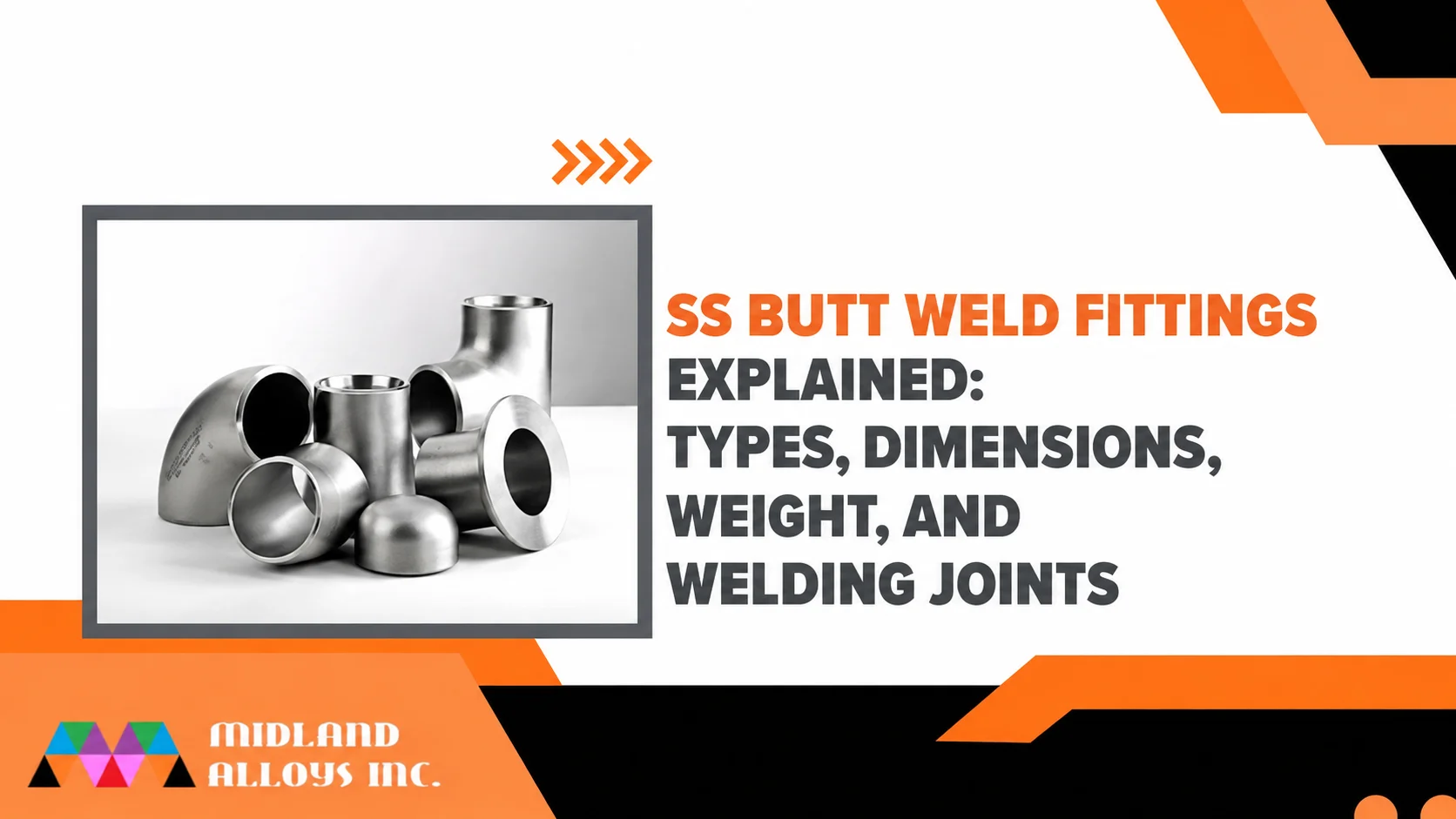
Butt weld elbows come in 45°, 90°, and 180° versions, with long- or short-radius choices based on layout and flow needs. Butt weld tees form branch connections as equal or reducing tees. Butt Weld Reducers change pipe size. Concentric reducers do not change the flow center. Eccentric reducers are good for drainage. Caps cover pipe ends, stub ends are equivalent to lap joint flanges, and cross fittings join four pipe runs together at one spot.
Standard Dimensions of SS Butt Weld Fittings
ASME B16.9 covers factory-made fittings, while MSS SP-43 applies to lighter corrosion-resistant types and ASTM standards define material properties. Sizes run from ½ inch to 48 inches NPS, from instrument lines to large pipelines. Typical wall schedules include SCH 5, SCH 10, SCH 40, SCH 80, SCH 160, and XXS, chosen by pressure requirements. Centre-to-end dimensions and bevel angles also help ensure correct weld fit.
Understanding Weight of Stainless Steel Butt Weld Fittings
Weight affects more than calculations; it influences freight charges, pipe rack support, and on-site handling. Final weight depends on fitting type, size, wall schedule, and steel grade. For example, a 90° long-radius elbow in SCH 80 is heavier than the same stainless steel pipe fittings in SCH 10. ASME B16.9 weight tables or supplier spec sheets provide the figures needed for procurement and shipping estimates.
Welding Joints Used with SS Butt Weld Fittings
Standard butt weld joints connect the pipe directly to the fitting. Single-V grooves work well for wall thicknesses up to about 20 mm, giving good access for welding and inspection. Thicker walls typically use double-V grooves from both sides to reduce filler metal and distortion. U- and J-grooves suit deeper welds above SCH 80. Full-penetration welds and qualified WPS/PQR procedures are essential under ASME Section IX.
Advantages of SS Butt Weld Fittings
Full fusion welding gives strength that matches the parent pipe. Leaks are rare since there’s no gasket surface to fail, and the smooth internal bore cuts down turbulence and wear. Maintenance drops off too, nothing to re-tighten or replace. Pressure ratings can go past 2,500 PSI depending on schedule, and a well-executed weld routinely lasts over twenty years.
Applications of Stainless Steel Butt Weld Fittings
These stainless steel butt weld fittings are widely used in oil and gas pipelines, petrochemical facilities, and chemical processing systems. Power plants rely on them for steam and condensate lines exposed to repeated thermal cycling. Food and beverage systems use the smooth bore to limit bacterial growth, pharmaceutical plants need crevice-free joints, and water treatment lines depend on them for filtration and chlorination. Marine projects often choose 316L or duplex for saltwater conditions.
Factors to Consider When Selecting SS Butt Weld Fittings
Start with the grade, matched to what the fitting will be exposed to chemically and thermally. Check the pressure and temperature rating against actual process conditions, not just what’s on paper. Look at the corrosion environment properly, chlorides especially. Wall thickness has to match the connecting pipe schedule or the weld won’t fit up right, and standards compliance under ASME, ASTM, and MSS needs checking too.
Quick Selection Checklist: fitting type, material grade, pipe size, schedule thickness, end connection requirements, applicable standards.
Choosing a Reliable Butt Weld Fittings Supplier
A reliable Butt Weld Fittings Supplier should offer standard sizes and be able to make custom configurations if necessary. They must show compliance with ASME, ASTM and MSS on every batch, not just say they do. Mill test certificates are very important as they trace material to the actual heat number. For critical fittings, dimensional checks, dye penetrant, and radiography help catch issues before site delivery.
Conclusion
SS Butt Weld Fittings are an essential component of stainless steel piping systems in the oil and gas, chemical processing, power generation, and pharmaceutical industries. Choosing type, size, weight and welding joint early will help to avoid fit-up problems and rework later on. Properly installed, these fittings are strong and will last for decades. Buy stainless steel fittings that are technical and compliant from a trusted Butt Weld Fittings Supplier.